It's 2 a.m., your newborn feels warm against your cheek, and the thermometer reads a number you have to look at twice. Your stomach drops. Take a breath: most fevers in babies are the body doing exactly what it's supposed to do — mounting a defense against a routine bug. But there is one rule in newborn care that has no exceptions, and knowing it ahead of time is the difference between freezing and acting.
This guide gives you that rule first, then the calmer, age-by-age version for everyone past the newborn stage.
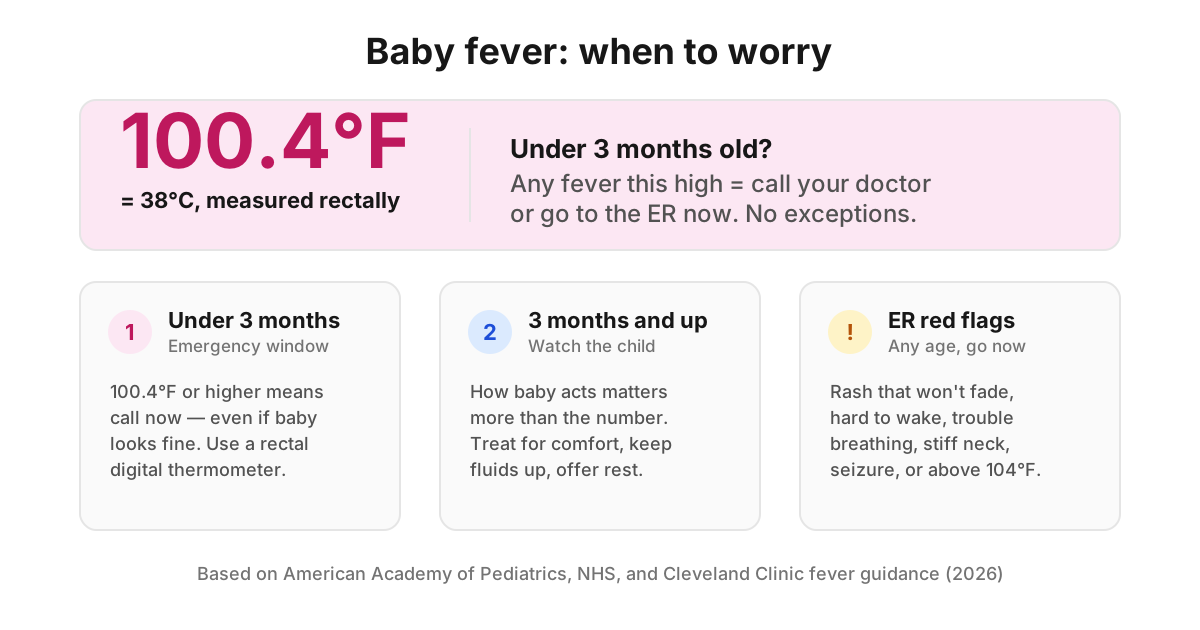
The one rule: 100.4°F under 3 months is an emergency
If your baby is younger than 3 months (12 weeks) and has a rectal temperature of 100.4°F (38°C) or higher, call your pediatrician or go to the emergency room immediately — day or night, even if your baby is feeding, smiling, and looks perfectly fine. This is the clear, unambiguous guidance from the American Academy of Pediatrics, and it is echoed by the NHS, which says the same for any baby under 3 months at 38°C or above.
Why so strict? A young baby's immune system is still immature, and the usual warning signs we rely on in older children haven't fully come online. A fever in these first weeks can be the only outward clue to a serious bacterial infection — and infections move fast at this age. Doctors don't wait to "see how it goes." They evaluate, often with blood, urine, and sometimes spinal-fluid testing, because catching it early changes outcomes. This is not a situation to manage at home or sleep on. Do not give fever medicine to lower the number before you've been seen, unless your doctor specifically tells you to.
That's the whole rule. Everything below is for babies and children past that 3-month line, where the calculus genuinely relaxes.
First, define "fever" — and measure it right
A fever is a body temperature of 100.4°F (38°C) or higher, full stop, according to both the AAP and Cleveland Clinic. Normal sits around 98.6°F, give or take a degree, and it drifts up a little in the evening and after activity — that's not a fever.
How you take the temperature matters, because the wrong method can send you to the ER over a number that isn't real (or, worse, falsely reassure you). The AAP's method-by-age guidance is worth memorizing:
- Under 3 months: rectal, always. A rectal reading with a digital thermometer is the most accurate, and it's the number that triggers the 100.4°F rule. Use a dab of lubricant, gently slide the tip in about 1/2 inch, and stop the instant you feel any resistance.
- 6 months and up: ear (tympanic) thermometers become reliable; before 6 months a baby's ear canal is too narrow.
- 4 years and up: oral readings work once a child can hold the thermometer under the tongue.
- Any age: a forehead (temporal artery) thermometer is convenient and fine for a quick check, but it's less precise — confirm a borderline number rectally in a young infant.
- Never use an old glass mercury thermometer. If one breaks it releases toxic fumes; digital is the standard now.
Armpit readings are the least accurate of all — treat them as a rough screen, not a verdict.
Past 3 months: watch the child, not just the number
Here's the mental shift that saves a lot of 3 a.m. panic. In babies over 3 months and in toddlers, how your child looks and acts matters more than how high the number climbs. Fever itself is a symptom, not the disease — it's the immune system turning up the heat to fight infection, and the height of the fever doesn't reliably predict how sick your child is.
The AAP's "Fever Without Fear" framing is exactly right: a child who perks up, drinks, and plays once a fever is brought down is usually weathering a routine virus. The child to worry about is the one who stays listless, glassy-eyed, and "off" even after the fever comes down. Treat the fever for comfort, not for the number on the screen.
For comfort and fluids:
- Offer plenty to drink. Keep breastfeeding or bottle-feeding on demand — a fever raises fluid needs.
- The NHS advises giving paracetamol (acetaminophen) or ibuprofen if your child is distressed or uncomfortable — dosed by weight, and ibuprofen only over 6 months. Don't alternate the two unless a clinician tells you to, and never give aspirin to a child.
- Skip the cold baths and sponging-down — they cause shivering, which can drive the temperature back up.
- Don't bundle a feverish child in extra layers.
When to call the doctor (past 3 months)
For an older baby or toddler, call your pediatrician — don't just wait it out — in these situations, drawn from AAP and NHS guidance:
- The fever repeatedly climbs above 104°F (40°C) at any age.
- A fever lasts more than 24 hours in a child under 2, or more than 3 days (72 hours) in a child 2 or older (the NHS uses a 5-day mark — when in doubt, call sooner).
- Your child still "acts sick" once the fever is down.
- There are signs of dehydration: far fewer wet diapers, no tears when crying, a dry mouth, or sunken eyes.
When it's an emergency — call 911 / go to the ER now
Some signs mean don't wait for a callback. Seek emergency care for a child of any age — fever or not — if you see, per AAP and NHS:
- A rash that does not fade when you press a clear glass against it (a possible sign of serious infection like meningitis or sepsis).
- Trouble breathing — grunting, flaring nostrils, or the skin sucking in under the ribs.
- Your child is unusually drowsy and hard to wake, limp, or unresponsive.
- A stiff neck, a severe headache, or sensitivity to light.
- A seizure, or skin that turns blue, grey, blotchy, or very pale.
- Repeated vomiting or any sign you simply can't shake that something is badly wrong. You know your baby; trust that.
A quick word on febrile seizures, because they're terrifying and more common than parents expect — they affect about 2% to 4% of children under 5. A brief one (under five minutes) is usually not dangerous and doesn't cause lasting harm, but always treat a first-time seizure as a reason to get emergency care, and call 911 for any seizure lasting more than five minutes.
Mayo Clinic's pediatric team walks through reading a thermometer and deciding what counts in this one-minute explainer:
What not to panic about
A few reassurances, because fear is the thing that makes 2 a.m. worse:
- Teething does not cause a true fever. It may nudge a baby's temperature up slightly, but anything 100.4°F (38°C) or higher is a real fever from something else — apply the rules for your baby's age and don't write it off as teeth.
- A fever won't "cook" your baby's brain. Ordinary infection-driven fevers, even high ones, don't climb to the rare extreme (above roughly 106°F / 41°C, per Cleveland Clinic) at which heat itself threatens organs. The fever is a response to the illness, not the danger.
- The exact number isn't a danger meter past the newborn stage. A 103°F in a playful, drinking toddler is less concerning than a 101°F in a baby who won't wake to feed.
- You're not overreacting by calling. Pediatric offices field fever calls constantly and would always rather hear from you. "Call your pediatrician" is never the wrong move.
When you're tracking a sick stretch, having the details handy helps the on-call nurse help you fast — jotting down each temperature, the time, the method, and any medicine you gave (and when) turns a panicky phone call into a useful one. You can log temps and symptoms in your TinyWins journal so the timeline is right there when you need it.
The bottom line
Memorize one number and one age: 100.4°F, under 3 months, call now. That single rule carries the weight, because it's the window where fever can be the only sign of something serious and where minutes matter. After 3 months, breathe — watch your child more than the thermometer, treat for comfort, and let the red flags above tell you when it's time to pick up the phone.
For more on the newborn weeks, see our newborn sleep survival guide. And while you're stacking the early-days basics in your favor, the same calm, evidence-first approach applies to bedtime — read the ABCs of safe sleep.
This article is educational and not medical advice. Always check with your pediatrician/provider.